
Chisholm Larsson Gallery: CL47120 Groupe Cayc: Dialogue avec l'Amerique Latine 1981 [x] close
CL47120
Poster ID: CL47120
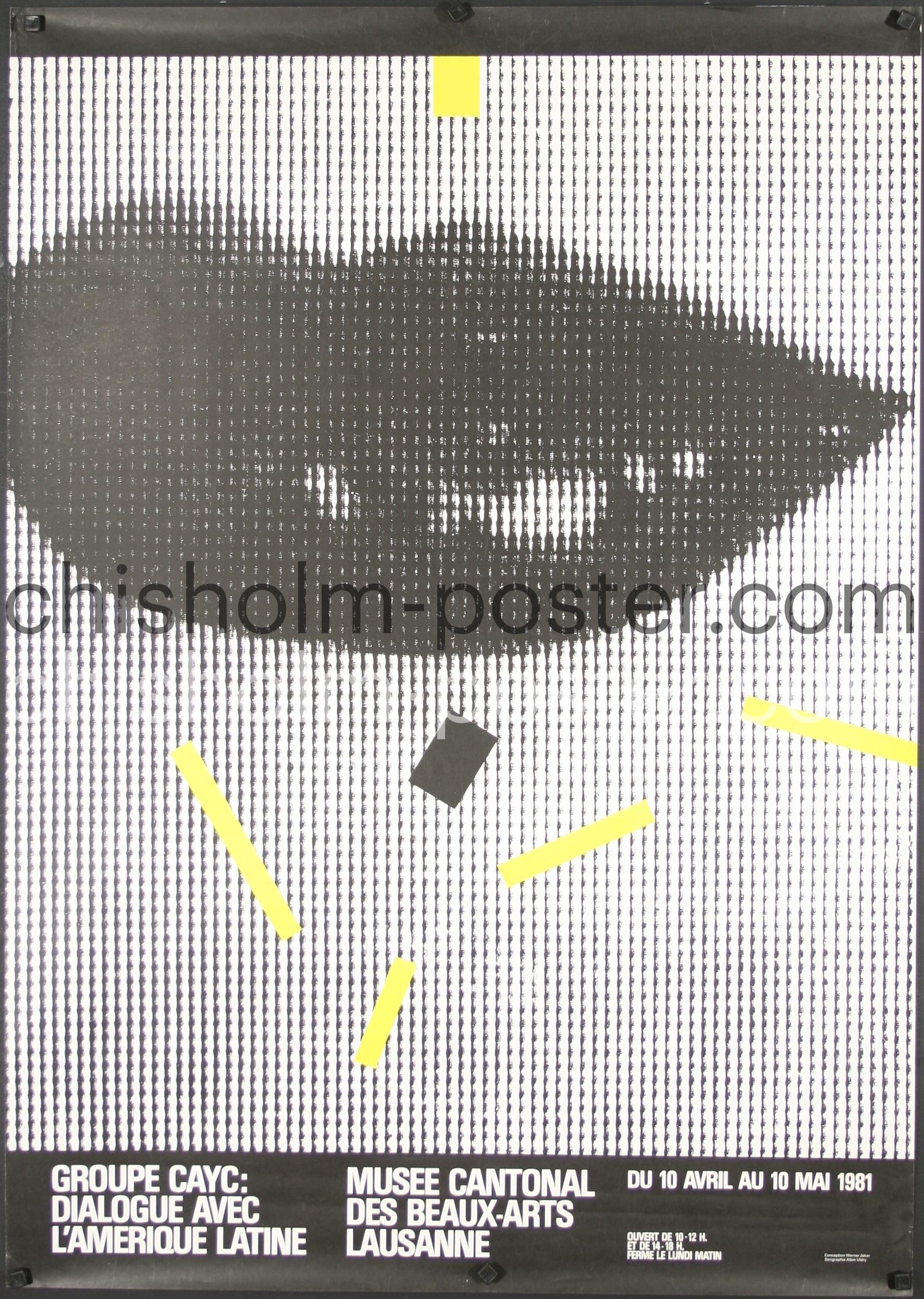
Original Title: Groupe Cayc: Dialogue avec l'Amerique Latine 1981
English Title: Centro de Arte y Comunicacion
Designer: Werner Jeker
Year of Poster: 1980s
Category: Miscellaneous/Exhibition and Exposition
Country of Poster: Swiss
Size: 51x36in.=125x85cm.
Condition: Very Good
Price: $450
Available: Yes
Notes: 1981
A historical example speaks to the centrality of the network in contexts in which resources or freedoms are limited. Inaugurated in 1969 by lighting entrepeneur and art critic Jorge Glusberg, the Centro de Arte y Comunicacion [CAYC] oversaw the majority of art production in Argentina in the 1970s and 1980s and served as a conduit for international artists and exhibitions traveling through the country.[4] Advocating an Argentine conceptual art that he dubbed, following artists such as Hans Haacke, arte de sistemas, Glusberg utilized his connections with the larger figures in New York conceptualism such as Lucy Lippard, Seth Sieglaub, and Willoughby Sharp to bring well-known American and European artists to CAYC, among them Dennis Oppenheim, Lawrence Weiner and Mel Bochner. Glusberg also promoted his own group of conceptual artists, which met weekly, worked collaboratively, and often attended biennials together. This Grupo de los Trece exemplifes an "avant-garde" that owed its very creation to an institutionally-based network.[5]

CAYC devised a uniform graphic design for its publications. Yellow leaflets, always in the same font, were distributed internationally for every show. Group exhibitions, such as the multiple iterations of Arte de sistemas allotted each artist the same amount of page space in the catalogues, often consisting of separate pages collected in a box.[6] These were templates here with a grid format as a substrate for each contribution that presented, quite tidily, difference within sameness. This practice of standardization was a ubiquitous formal device for CAYC, an analogy for its larger ambition as a network. The collection and assimilation of artists of different nationalities and practices seeks to elide distinctions (formal, cultural, political) between them. That being said, the Center's focus always returned to Argentine conceptual artists
Add to Cart E-Mail to a Friend